

Trusted AI – Sovereign AI for Public Authorities, KRITIS & Regulated Organizations
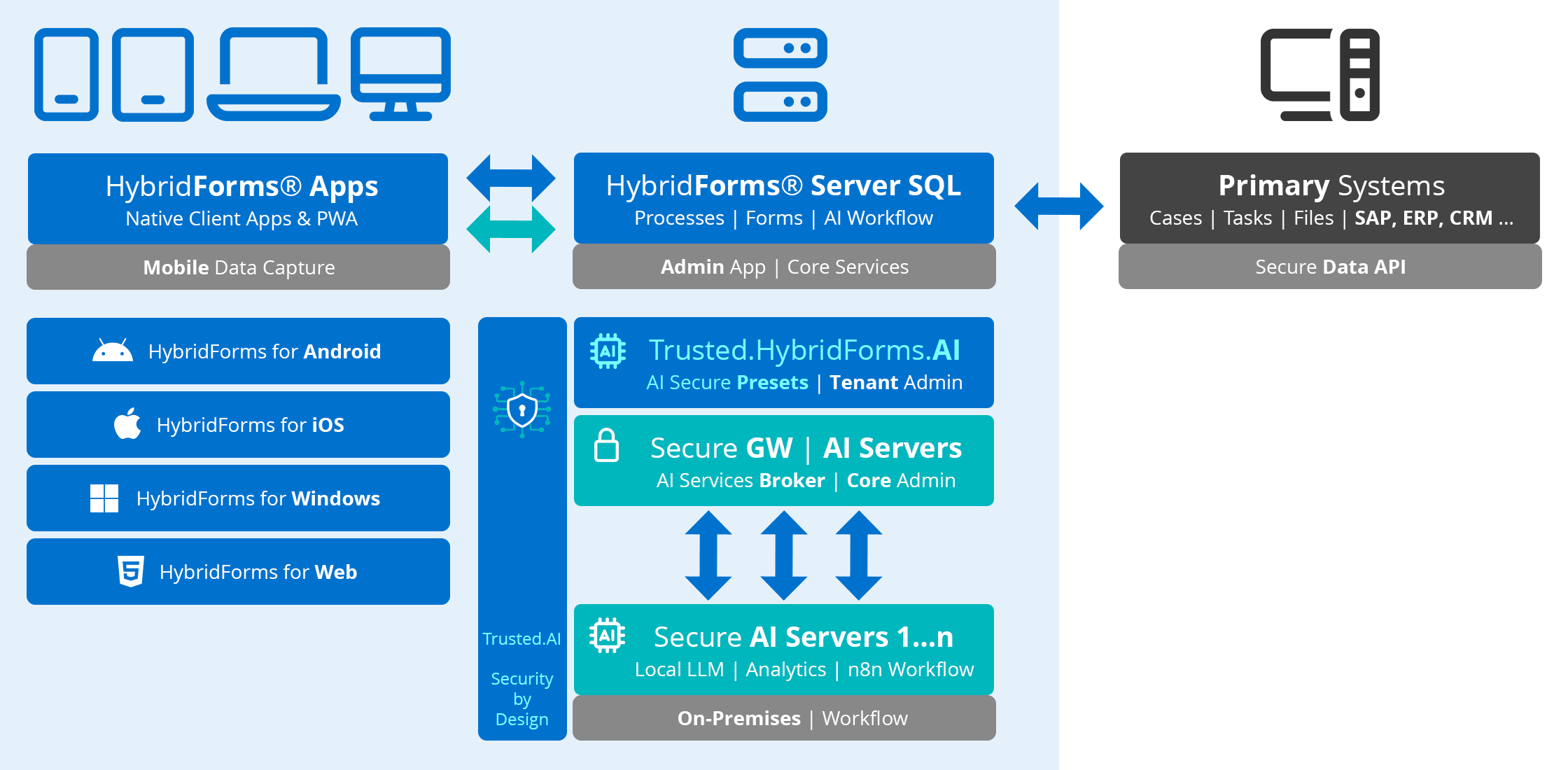
Artificial intelligence is changing the way organizations capture data, process it, and make decisions. But for the public sector, security authorities, and critical infrastructures, one principle takes precedence over all efficiency: trust comes before speed. HybridForms responds with Trusted AI – a concept that combines AI capability with absolute control over data, infrastructure, and decision-making processes.
What is Trusted AI?
Trusted AI describes an AI concept in which every function is explainable, controllable, and fully compliant. No black box, no uncontrolled data flows to external services, no structural dependency on American or Asian platform providers.
In practice, this means: AI models and AI inference are operated entirely within the organization’s own infrastructure – on-premises, in a private cloud, or in a sovereign European hosting environment. Data control remains with the operator. For highly regulated domains such as law enforcement, government agencies, healthcare, and critical infrastructure operators, this is not an option but a fundamental prerequisite: operational and citizen data must never leave the controlled environment at any time.
The Security Model: Secure AI Presets & AI Services Broker
HybridForms implements Trusted AI through two core technical pillars:
HybridForms.AI Secure Presets
Purely administratively managed configuration profiles control which (detailed inference) AI functions are activated in which context. Privacy levels, models, and output filters are defined centrally – and cannot be viewed (and therefore not changed) by individual users or even process designers. Privacy is thus enforced, not expected on a trust basis.
HybridForms.AI Services Broker
The integrated AI Services Broker is the heart of the Trusted AI architecture – an intelligent control center between HybridForms and the AI models in use. This function is highly administrative and accessible only to users with the highest security clearance. It manages routing, logging, access rights, and the selection of permitted endpoints – both internal and external. Administrators thus retain full oversight and control over the entire AI deployment within an application at all times. Crucially: different AI models can be operated in parallel and selected according to context. If the organization switches AI providers or introduces new models, HybridForms continues to run without interruption. No adjustments to forms, processes, or workflows are necessary.
Audit trail & explainability
Every AI-assisted action in mobile form processes and digital workflows is comprehensively documented and traceable. For public authorities and regulated industries, this traceability is an indispensable compliance requirement.
Role-based AI governance
AI access and AI permissions follow the existing role and permission model of HybridForms. Field personnel, back-office clerks, and administrators receive precisely the AI support that corresponds to their function and security level.
On-Premises instead of Hyperscalers – Data Sovereignty as Standard
The major American cloud providers have democratized AI as a service. For organizations operating under GDPR, BSI IT-Grundschutz, NIS2, or sector-specific regulations, however, outsourcing sensitive data to external clouds is often legally impermissible – and always a loss of sovereignty.
»Anyone who does not know and cannot control their AI infrastructure does not know the risks either – and cannot take responsibility for them.« Martin Bene, CTO and Managing Director of icomedias, on the HybridForms Trusted AI principle
HybridForms is designed so that AI models and inference are operated entirely on dedicated servers, in dedicated data centers, or in sovereign European cloud environments. No data leaves the organization in an uncontrolled manner.
Target Groups: Who Benefits from Trusted HybridForms.AI
Trusted AI in HybridForms is aimed at organizations where data breaches or uncontrolled AI use would have existential consequences:
Assistive AI Functions in Practice: Mobile Forms & Workflows
Trusted AI in HybridForms is not an autonomous system – it is an assistive tool that provides targeted support to specialists without replacing their oversight and approval responsibilities. AI functions are exclusively requested actively and in direct processing context: the professional user reviews, evaluates, modifies, and approves. Automated exclusions or independent decisions are conceptually excluded.
This concept is designed to meet the requirements for human oversight and control under the EU AI Act: AI acts exclusively in the directly requested processing context by trained personnel – without autonomous decisions, without dynamic suggestion mechanisms, and fully operable on dedicated servers.
In practice, a range of assistive functions are available directly within the form and workflow context, for example:
All functions operate within the security architecture of the AI Services Broker – seamlessly integrated for the user, fully controlled for the administrator, and granularly configurable via Secure AI Presets. The broker layer is administered at the highest level and is not accessible even to tenant administrators.
Compliance by Design: Security, Privacy & EU AI Act
European AI regulation is taking shape. The EU AI Act classifies AI systems in the areas of public safety, critical infrastructure, and law enforcement as high-risk systems with far-reaching requirements for transparency, documentation, and human oversight.
HybridForms Trusted AI is designed from the ground up for these requirements. Audit trail, granular AI governance via the AI Services Broker, and complete local data storage form the technical foundation for demonstrable compliance – not as a retroactive effort, but as an integral part of the product design. Security by Design, Privacy by Design, and Compliance by Design are not marketing promises but architectural principles embedded in every layer of the platform.
Organizations can thus demonstrate: AI systems are under human control, data is not processed in an uncontrolled manner, and decision-making processes in mobile form processes as well as back-office workflows are fully documented.
Supported Regulatory Frameworks (specific to implementation):
Made for Europe: Digital Sovereignty
Digital sovereignty is no longer an ideological position – it is a strategic necessity. Organizations that have made critical infrastructure and processes dependent on a few global providers are increasingly experiencing the fragility of this dependency: geopolitical shifts, data scandals, or changed terms of service by major platforms.
HybridForms implements digital sovereignty technically and architecturally – equally in mobile form processes, in complex review and approval workflows, and in the AI layer. Those who wish to deploy AI without relinquishing control over their own data will find in HybridForms a platform that consistently delivers on this promise.
Made for Europe is a design decision: for European data protection law, European transparency and accountability standards, and European technical norms. In a world where AI is becoming part of critical infrastructure, trust matters more than any question about the range of features.